Joy – Advent 2023

Newborn babies always bring an unspeakable joy, a light behind the eyes, a glow of warmth to the heart of the one who holds them. Mary and Joseph no doubt felt this joy as they held their newborn son, Jesus.

But the advent of Jesus brought a new understanding of joy. Joy is not only to be felt when our hands and hearts are full. Certainly, we should be joyful in making memories around the Christmas tree, seeing the delight on little faces on Christmas morning, and holding loved ones we haven’t embraced in years.

But what about those who ache over the empty seat at the table where their loved one used to sit? What about those who are alone on Christmas morning? Can they be joyful?

Jesus came to bring us joy even in our sadness and suffering.

Habakkuk 3:17-18 says:

“Though the fig tree should not blossom, nor fruit be on the vines, the produce of the olive fail and the fields yield no food, the flock be cut off from the fold and there be no herd in the stalls, yet I will rejoice in the LORD; I will take joy in the God of my salvation.”

Jesus came to bring us a joy that far outweighs any temporal happiness this world can offer:

“You have put more joy in my heart than they have when their grain and wine abound” (Psalms 4:7).

The reason this joy is greater than anything else can offer is because the source of this joy is God himself. This joy is only found in his presence.

You make known to me the path of life; in your presence there is fullness of joy; at your right hand are pleasures forevermore” (Psalms 16:11).

“The hope of the righteous brings joy,” and that hope is found in the coming of our Savior, “who for the joy that was set before him endured the cross, despising the shame, and is seated at the right hand of the throne of God” (Hebrews 12:2).

Jesus looked past his suffering to the greater joy of redeeming you and I from our sins so that we could share in his perfect joy for eternity.

So, this Christmas season, whether your tree is bountiful or barren, look to Jesus who came to be our exceeding joy and place your hope in him.

Flashback Friday – Let the Nations Be Glad . . . That’s What She Wanted

Here I am at CROSS Conference in Indianapolis, taking a youth group to hear about God’s plan for missions. It is here that I am struck with thoughts of my friend, Danielle.

Why do I miss her so much more when I’m at a missions conference? Maybe it’s because she spent a year of her life as a teacher-missionary in South Sudan. Maybe it’s because I can picture her being here with me, and the thought makes me cry right in the middle of the crowd of conference-goers. But most of all, it is because she loved missions so much. She would be so excited to see all the different opportunities and ways God has been working around the globe; exuberant about taking the name of Christ to the nations. She would be beaming from ear to ear, green eyes glittering with excitement, bouncing up and down as she pulled me from booth to booth, talking a million miles a minute.

Her passion to make Christ known to unreached people groups puts me to shame. My husband tells me that she would have been thrilled that I am taking a group of young people to learn about missions and how they can “go.” I know she would; she was always encouraging me. But still I pray, at this conference, that God will stir my lukewarm heart to be as concerned as she was about the state of souls; souls that are lost in darkness all over the world.

May Christ be brought to those dark corners of the world, where no one has ever heard his name, so that the nations will be glad and God would be glorified. She wanted that more than anything.

Are You in the Fight?

Therefore, since we are surrounded by so great a cloud of witnesses, let us also lay aside every weight, and sin which clings so closely, and let us run with endurance the race that is set before us, looking to Jesus, the founder and perfecter of our faith, who for the joy that was set before him endured the cross, despising the shame, and is seated at the right hand of the throne of God. Consider him who endured from sinners such hostility against himself, so that you may not grow weary or fainthearted. In your struggle against sin you have not yet resisted to the point of shedding your blood. (Hebrews 12:1–4)

It seems that every day I struggle with the same sins over and over. 

Sometimes it is frustrating, sometimes it is discouraging, and other times I am in such despair that I break down crying and pleading for God to help me. I always ask, “Why do I keep on sinning?” And sometimes, “Why do I keep doing this same sin over and over? Shouldn’t I be able to get a handle on this by now?”

I know that because of my broken, sinful nature I will keep sinning until I die. I also know that as a believer, the grace of Christ reigns in my life and my sins are no longer held against me. Does that mean we should not worry when we sin because it’s just the way we were made and we have already been forgiven? After all, we have grace, right?

In Romans chapter six, Paul writes, “What shall we say then? Are we to continue in sin that grace may abound? By no means! How can we who died to sin still live in it?”

Likewise, Romans 6:6–7 says, “We know that our old self was crucified with him in order that the body of sin might be brought to nothing, so that we would no longer be enslaved to sin. For one who has died has been set free from sin.”

It is clear that we are no longer supposed to live in sin, but I am failing. If you are like me then you may be asking, “What are we supposed to do? Why is this so hard?”

It is now that we must truly consider Hebrews 12:3–4:

“Consider him who endured from sinners such hostility against himself, so that you may not grow weary or fainthearted. In your struggle against sin you have not yet resisted to the point of shedding your blood.”

There are those words—in your struggle against sin.

My struggle? Many of us have heard the Christian life described as a path, a race, a fight, but here we see it called a struggle! Have you ever considered that? That our life would be a struggle? That we aren’t promised it will be easy to be a Christian but are actually told the opposite?

Matthew 7:13–14says, “Enter by the narrow gate. For the gate is wide and the way is easy that leads to destruction, and those who enter by it are many. For the gate is narrow and the way is hard that leads to life, and those who find it are few.”

First Peter 4:12–13 says, “Beloved, do not be surprised at the fiery trial when it comes upon you to test you, as though something strange were happening to you. But rejoice insofar as you share Christ’s sufferings, that you may also rejoice and be glad when his glory is revealed.”

And 1 Timothy 6:12 says, “Fight the good fight of the faith. Take hold of the eternal life to which you were called and about which you made the good confession in the presence of many witnesses.”

We have to fight! We must fight our sin with everything in us and keep watch over our hearts! We have to be alert! Knowing this life is going to be a struggle is an advantage to us. If we know it is going to be hard, then we can gear up for it; gird our loins to be prepared for action; put on the full armor of God and go to our battle stations!

And what is our best weapon? “The sword of the Spirit, which is the word of God” and “praying at all times in the Spirit” (Ephesians 6:17).

The very fact that we are believers means we have the Holy Spirit living inside of us giving us power and strength to fight. The fact that Jesus took upon himself all of the Father’s wrath that we deserved for our sin and made the perfect payment (perfect in his power to completely remove all our sin and perfect in his worth—a sacrifice holy, unblemished and acceptable to his Father) means that we no longer have to sin. 

Christ defeated the power sin had over us by what he did on the cross. We are free people. Sin is no longer our master. We are called to live as free people and like Christ’s sacrificial death actually means something to us. We are to live like Christ.

Ephesians 4:1 says, “I therefore, a prisoner for the Lord, urge you to walk in a manner worthy of the calling to which you have been called.”

Then what are we to do when the Christian life gets hard? When it gets so tough to fight our sin that we feel like giving up or giving in?

Consider him who endured from sinners such hostility against himself, so that you may not grow weary or fainthearted. In your struggle against sin you have not yet resisted to the point of shedding your blood. (Hebrews 12:3-4)

Consider what Christ went through. Our Savior hung for six hours on a cross—tired, bruised, beaten, bleeding, gasping for every breath, dying. On top of that suffering, he endured the most painful thing imaginable: the full wrath of his Father God being poured out on him for our sin. And yet he endured, for he considered what glory his death would bring the Father and what joy there would be in redeeming a people for himself.

If we are in Christ, we never have to take that punishment upon ourselves. We will never have to shed our blood to free ourselves from sin. Christ already accomplished it all. But we do have to fight our temptations and our sins every day and fight with everything in us. And when you have the Holy Spirit inside of you, that is a lot of power!

If we are looking to our Savior and considering what he endured to win this battle over sin for us, then we will not grow weary or fainthearted. What might we have to give up to fight our sin? Some time, energy, sleep, selfishness, or even something or someone very dear to us? What is that compared to what our Savior sacrificed—his very life.

With that in mind, there are some questions we must consider:

Are we fighting our sin? Are we putting forth great effort and exertion to put off sinful desires, selfishness, and pride, and to put on Christ and live the way he has called us to live?

If we are not fighting our sin, why is that? Have we sunk into Christian complacency, living as if the moment of our salvation is enough to carry us through to the end? If this is you, I urge you to consider these words from the late great preacher, John Owen, “Be killing sin or it will be killing you.” Sin is not complacent; it is crouching at our doorstep, and it wants to have mastery over us.

Our Lord warned us in Matthew 24:13, “But the one who endures to the end will be saved.” Similarly, James wrote about remaining steadfast under trial: “Count it all joy, my brothers, when you meet trials of various kinds, for you know that the testing of your faith produces steadfastness. And let steadfastness have its full effect, that you may be perfect and complete, lacking in nothing” (James 1:2–4), and “Blessed is the man who remains steadfast under trial, for when he has stood the test he will receive the crown of life, which God has promised to those who love him” (James 1:12).

We must fight and we must endure, and we must do it with all joy so that in the end we may obtain the crown of life. Are you enduring or coasting?

If this all sounds like a foreign concept to you and you don’t really understand what you have just read, my question to you is: Do you know Jesus Christ the Savior and his redeeming power? Do you have a relationship with the one true God who made you—the only One who can free you from a life of sin?

If you do not know him, I urge you to call out to God and seek his salvation—be free from the bondage of sin, obtain the crown of life that is only given to us in Christ, and look to him as you run the race with endurance, following in the faithful footsteps of the saints who ran before you.

The previous blog was originally published at https://lifeword.org/blog/are-you-in-the-fire/

Love – Advent 2023

It’s the most wonderful time of the year. There’ll be holiday greetings and friends coming to call. It’s the time of year to throw around phrases like Merry Christmas and Happy Holidays, to be of good cheer to every cashier and barista in sight. But what does it mean when we wish someone a Merry Christmas?

We’re intending to spread a message of love and happiness, but many times it feels like we’re offering up an empty phrase. Like saying “Be warmed and filled” to a hungry, homeless person on a subzero day without giving them a warm place to stay and a sandwich.

Why do our intentions fall flat? Because love must be more than a well-wished, fuzzy feeling. Love must have purpose; love must have meaning; and love must be demonstrated with action.

The angels announced the birth of Christ with glad tidings that would bring great cheer. But the long-awaited Messiah didn’t appear to bring us warm, cozy feelings of parties, toasted marshmallows, and Christmas carols.

First John 3:5 says, “You know that he appeared in order to take away our sins.”

Jesus Christ came with a message of love, but it was a message of love from a God who came to rescue unlovely sinners like you and me.

His love came with a purpose: to redeem us from an eternity of punishment that our sins deserve so we could spend eternity glorifying and enjoying the most loving being in existence—God himself.

His love came with a meaning, displayed to us in God’s perfect character because he is the very definition of love.

And his love came with a demonstration:

“For this is the way God loved the world: He gave his one and only Son, so that everyone who believes in him will not perish but have eternal life” (John 3:16, NET).

“Greater love has no one than this, that someone lay down his life for his friends” (John 15:13, ESV).

This holiday, instead of greeting our friends, family, and acquaintances with “Merry Christmas,” let’s say, “I hope you know the love of Christ this season.” Then share the meaning of that love which came to us as a baby that very first Christmas, gave his life for us, and soon will be coming again.


Flashback Friday – Danielle

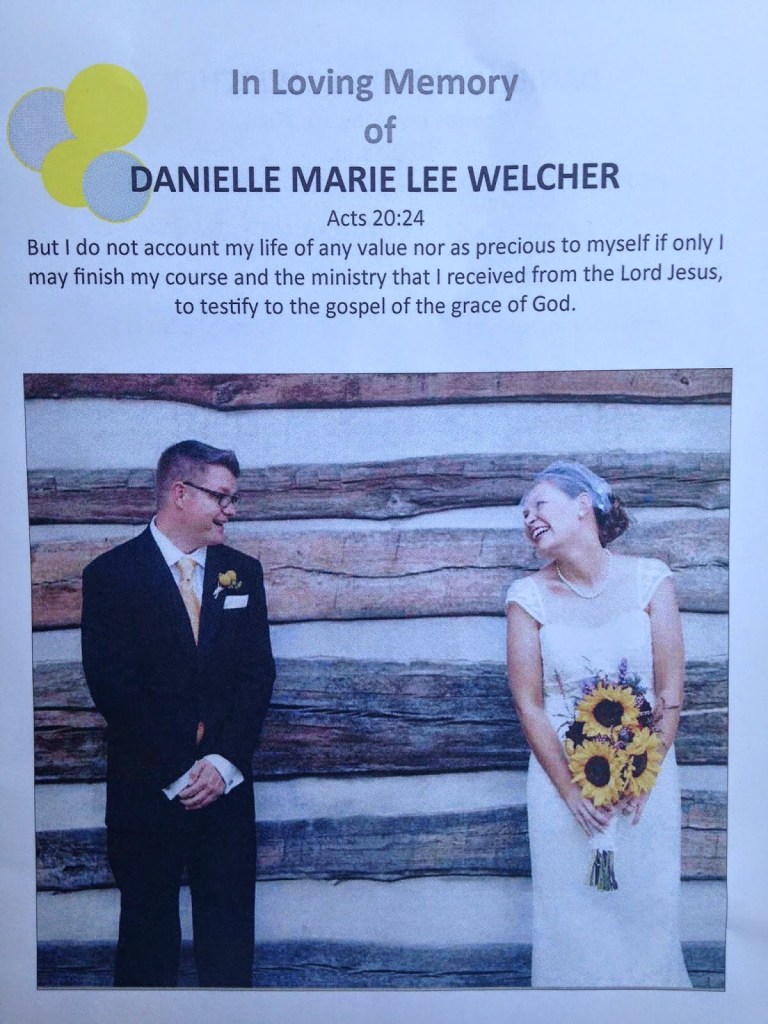
On Saturday, May 10, 2014, I went to the funeral of my best friend of 10 years, Danielle. The theme that resounded throughout the service was how she lived a life that was totally sold out to Christ. In her Bible she wrote that she wanted to be a woman of grace and mercy. Her number one mission in life was to make the glory of God known through the face of Jesus Christ by sharing the gospel with others. She counted her life as nothing but an instrument in the Redeemer’s hands, and she wanted to serve God and others at any cost to herself.

She was only 30 years old but every ounce of her life was filled to the brim and overflowing with passion for her God, which caused her to love and serve others with full abandon to what this world holds dear. Just as my husband John said last week and Danielle’s brother, Mark, said in his eulogy, Danielle wanted to glorify and serve God with her life SO much that she would have done whatever it took to accomplish that. Even if she would have known ahead of time it would mean sickness, pain, and eventually death, she would have GLADLY signed up for it, if that is what would bring him the most glory. And he has been glorified in her life and will continue to be glorified in her death as the testimony we share about her makes his greatness known. She accomplished her one desire in life. Now she is worshipping around the throne of her Savior for eternity and beaming with unending joy in his presence.

At the service, they read some of the notes Danielle had written in her Bibles, and this was the verse she had written out several times, which I believe describes her life:


But I do not account my life of any value nor as precious to myself, if only I may finish my course and the ministry that I received from the Lord Jesus, to testify to the gospel of the grace of God. (Acts 20:24)

Another verse was:

But as for you, O man of God, flee these things. Pursue righteousness, godliness, faith, love, steadfastness, gentleness. Fight the good fight of the faith. Take hold of the eternal life to which you were called and about which you made the good confession in the presence of many witnesses. (1 Timothy 6:11-12)

Danielle pursued righteousness, godliness, faith, and love. She fought the good fight of faith, all the way to the end. And now she has taken hold of the eternal life to which she was called, forever resting in the Savior’s arms.

Danielle was heavily involved in youth ministry, was a history teacher at a Christian school, served in short-term missions to Eastern Kentucky with Kentucky Mountain Mission, and was a long term missionary to South Sudan for a year. This was all while she patiently waited on the Lord for his timing and providence in giving her a godly husband, using her singleness to serve. Then God brought her Evan, who pursued her for marriage, and they became husband and wife July 9, 2011. Evan modeled the Ephesians 5 husband, and truly washed Danielle in the Word. He lovingly referred to her as his “Resplendent Bride.”

Danielle’s life was not wasted. Many people struggle with her death because she was only 30 years old. They say things like “Her life was cut way too short!” or “I just can’t make sense of it. She was too young!” While I understand the difficulties of grief (because I too am grieving over losing her), and it is hard to wrap our minds around God’s plan (Isaiah 55:8-9), it is just that—God’s plan. God ordained every one of Danielle’s breaths and he intricately wove his plan for her life into every fiber of her being (Psalm 139:13-16). His will for every believer is that they would be conformed to the image of his Son (Romans 8:28-30), and he worked everything in Danielle’s life to make her more like the Savior. I don’t know why God purposed that cancer would be one of his means to sanctify Danielle, but he did and she was. And who am I to answer back to God (Romans 9:20)? Of course, I selfishly wish I had more time with her, to enjoy her friendship and to be a good friend in return, but I am confident that God’s will is best, more than best; it is perfect. And he has made her perfect in Christ. And I can rejoice in that truth.

I love you and miss you, dear friend. This is not goodbye; it is only so long, until we meet again.

Hope – Advent 2023

The people who walked in darkness
have seen a great light;
those who dwelt in a land of deep darkness,
on them has light shone.
Isaiah 9:2


Darkness.

God’s people sat in darkness for 400 years. There were no prophets, no word from the Lord—only silence.

The long-promised Messiah who would right all the wrongs and restore God’s people hadn’t come. The people were weary of waiting. There was no one to rescue them. Hope had been forgotten by most.

But then—a faint glimmer in the night. The twinkle of a star in the east, glowing like a small candle in a dark room, pointing to the little town of Bethlehem.

Hope.

Slowly, the light of hope spread. First to a virgin girl of low estate, then to shepherds in a field, then to wisemen in the east.

The small cry of a newborn babe broke the long, bleak silence.

And suddenly, hope was here in the flesh, in the form of a baby—Jesus, who would grow into a man and save his people from the darkness and gloom of their sins.

Jesus. The only light of hope in our darkest days. The only rescue from the weariness and burden of our sins. The only one who will sustain us and give the rest of our days purpose and meaning as we set our hope fully on the grace that will be brought to us at his return.

As we light this candle, let us hold fast the confession of our hope without wavering, for he who promised is faithful. May the God of hope fill you with all joy and peace in believing in his Son, Jesus Christ, so that by the power of the Holy Spirit you may abound in hope, this advent season and all year long.

Flashback Friday – The Wisdom of the Young: Meditations on Job 32

Have you ever felt like no one would listen to you because you were the youngest person in the room? Like you would be dismissed simply because of the date stamped on your driver’s license? What if you actually had something truthful and of value to say? Should you stay silent and acquiesce to the aged?

In the first 31 chapters, Job is afflicted, his three friends come to comfort him (and do a good job of it until they open their mouths), then Job and his friends proceed to argue back and forth like a bunch of whiny high school kids. His friends insist that he must be unrighteous or else God wouldn’t have afflicted him, and Job insists that he hasn’t done anything wrong and has every right to complain. His friends have nothing of much substance to offer him in his affliction and have a skewed, at best, view of God’s mercy and sovereignty. They go round and round and round, until finally a refreshing new voice appears and smacks some sense into them. Enter Elihu, a younger contemporary, who begins to speak:

Now Elihu had waited to speak to Job because they were older than he. And when Elihu saw that there was no answer in the mouth of these three men, he burned with anger. And Elihu the son of Barachel the Buzite answered and said: “I am young in years, and you are aged; therefore I was timid and afraid to declare my opinion to you. I said, ‘Let days speak, and many years teach wisdom.’ But it is the spirit in man, the breath of the Almighty, that makes him understand. It is not the old who are wise, nor the aged who understand what is right. Therefore I say, ‘Listen to me; let me also declare my opinion.’ Behold, I waited for your words, I listened for your wise sayings, while you searched out what to say. I gave you my attention, and, behold, there was none among you who refuted Job or who answered his words. 

“They are dismayed; they answer no more; they have not a word to say. And shall I wait, because they do not speak, because they stand there, and answer no more? I also will answer with my share; I also will declare my opinion. For I am full of words; the spirit within me constrains me. Behold, my belly is like wine that has no vent; like new wineskins ready to burst. I must speak, that I may find relief; I must open my lips and answer.” (Job 32:4–12, 15–20)

Sometimes as young people, we can relate to Elihu. We feel like we have so much to say about God’s truth that we might burst if we don’t get it out! But we may also think that no one will listen to us because we are chronologically young; they may infer that we must not have wisdom. Often we are silent because we don’t want people to think we are acting like “know-it-alls” or that we like hearing ourselves talk. But the disappointing flipside is that so often the “advice” we hear from older people is not solidly rooted in God’s Word. Why is this so?

In verses 8–9 of Job 32 (and other places in the Bible), it says that spiritual maturity and wisdom are not necessarily congruent with length of years; they are given by the Spirit.

But it is the spirit in man, the breath of the Almighty, that makes him understand. It is not the old who are wise, nor the aged who understand what is right” (Job 32:8–9).

Understanding must come from the Spirit. First, a person must be a believer to have true spiritual understanding. First Corinthians 2:14 says, “The natural person does not accept the things of the Spirit of God, for they are folly to him, and he is not able to understand them because they are spiritually discerned.” A lost person will not be able to offer any wisdom because true wisdom is only given by the Spirit. Without God’s Spirit in them (which comes at conversion), God’s ways are foolishness to them. They may offer worldly wisdom, but its end only leads to death (Proverbs 16:25). 

But even amongst believers, there are varying degrees of wisdom and understanding. Since Scripture makes it clear that it is not those who are advanced in years who are necessarily wiser, then on what does it depend? The “X” factor here is sanctification, or growth in holiness. God promises that if he has made you his child (i.e., he has regenerated you by his Spirit and given you a new heart that caused you to repent and believe in Christ alone for your salvation from sin) that he will make you progressively and increasingly more like his Son as you walk with him (Rom. 8:29-30; Phil. 1:6; 2 Cor. 3:18). So in a true sense, everyone who is in Christ is growing. But the “Parable of the Sower” in Matthew 13 also tells us that believers grow at different rates. 

“As for what was sown on good soil, this is the one who hears the word and understands it. He indeed bears fruit and yields, in one case a hundredfold, in another sixty, and in another thirty” (Matthew 13:23).

 All true believers in Christ will grow, but in the end, some will have matured more than others, which will be evidenced by their fruit. So is it possible for a believer who is younger chronologically to be more spiritually mature than a senior saint? Absolutely! Saints who are older chronologically, or even those who have been walking with the Lord longer, still may not be as spiritually mature as a younger-aged Christian. If they haven’t participated as much in the means of grace (Bible reading, prayer, Scripture memory, meditation, etc.) then they will not be producing a very big fold. 

So should younger-yeared saints keep silent? Should older saints automatically dismiss them for their youth? Paul tells Timothy, “Let no one despise you for your youth, but set the believers an example in speech, in conduct, in love, in faith, in purity” (1 Timothy 4:12). Just because someone is young in years, doesn’t mean they have nothing wise or truthful to say. Of course it is always important to respect your elders—or else be eaten by bears (2 Kings 2:23–24; Rom. 13:7; 1 Tim. 5:1–2), to never think more of yourself than others (Rom. 12:10; Phil. 2:3–4), and to never think yourself wise in your own eyes (Rom. 12:16). But if God has placed his Spirit inside of you and given you truth to speak from his Word, you do not have to be afraid to give counsel just because you are young! Remember:

“A word fitly spoken is like apples of gold in a setting of silver. Like a gold ring or an ornament of gold is a wise reprover to a listening ear” (Proverbs 25:11–12).

So speak up young people!

Flashback Friday – The Sting of Death

A short devotion on 1 Corinthians 15:56-57 from my morning reading:

“The sting of death is sin, and the power of sin is the law. But thanks be to God, who gives us victory through our Lord Jesus Christ” (1 Corinthians 15:56-57).

Sin is like a venom, a poison, that slowly seeps through the whole body, spreading to every vein and limb. It will eventually be the death of us (Romans 3:23).

But where does sin get its power? Or simply put, why does it even matter if we sin?

“The power of sin is the law” (15:56).

If there was no law, no commandments, then sin wouldn’t matter. Without good there could be no knowledge of bad (Romans 3:19-20, 5:12-13, 7:7-13).

While human laws are not perfect, there is a perfect law, given by the perfect, holy, and just Creator and Judge of the Universe. And every offense against that law is the vilest act of treason against the Most High King and deserves the greatest of punishments.

“But thanks be to God who gives us victory through our Lord Jesus Christ” (15:57).

Jesus Christ, the God-Man, stepped into his Father’s courtroom and said, I will pay the penalty owed to set these rebels free. And give them my perfect life credited to their account, that they may be seen as righteous before you.

Now the one who trusts in Christ and what he has done can say:

“O death, where is your victory? O death, where is your sting?” (15:55).

“Wretched man that I am! Who will save me from this body of death? Thanks be to God through Jesus Christ our Lord!” (Romans 7:24-25a).

The Secret to True Happiness (Part 2)

(This post is part two of yesterday’s post The Secret to True Happiness (Part 1))

“[Happy] are the merciful, for they shall receive mercy.
“[Happy] are the pure in heart, for they shall see God.
“[Happy] are the peacemakers, for they shall be called sons of God.
“[Happy] are those who are persecuted for righteousness’ sake, for theirs is the kingdom of heaven.
“[Happy] are you when others revile you and persecute you and utter all kinds of evil against you falsely on my account. Rejoice and be glad, for your reward is great in heaven.”
(Matthew 5:7–12)


People who are merciful are truly happy. When Peter asked how many times he should forgive someone who sins against him, Jesus replied with a story about a wicked servant who was forgiven a lifetime debt by the king and yet would not forgive a fellow servant a debt of a few days’ wages. Since the first servant was not merciful, he was thrown into jail until he could pay. Why? Because mercy should be a cycle. Those who have received mercy should want to show mercy to others, and those who show mercy to others can have confidence they will receive mercy in the end. Being the recipient of mercy should cause us to recognize how undeserving we are to have our sins forgiven by a perfect, holy God. Our sins are like the first servant’s debt—they would take an eternity to pay—an impossible task. Yet God, through the transaction that took place on the cross through Christ, chose to set his love and mercy on us. This should elicit our immense humbleness and gratefulness over the sheer wonder of this underserved miracle. When you have received that kind of mercy, you will be happy to extend mercy to others, and you can be confidently happy that you will receive mercy on the last day.

People who are pure in heart are truly happy. Something pure is spotless, perfect, free from all blemish, defect, or perversion. Our hearts must be this way in order to see God. Psalm 24:3–4 confirms this when it says, “Who shall ascend the hill of the LORD? And who shall stand in his holy place? He who has clean hands and a pure heart, who does not lift up his soul to what is false and does not swear deceitfully.” At first, this seems like bad news because, if we are honest, none of us always does what is right or has untainted motives. None of us should be allowed in God’s holy presence since he cannot even look upon sin (Habakkuk 1:13). And even worse, none of us can cleanse our own heart. “Who can say, ‘I have made my heart pure; I am clean from my sin’?” (Proverbs 20:9). Does that mean we never stand a chance to be happy? The good news is that God does not leave it to chance or to our own hands. Ezekiel 36:25–26 says, “[God] will sprinkle clean water on you, and you shall be clean from all your uncleannesses, and from all your idols [God] will cleanse you. And [God] will give you a new heart, and a new spirit [God] will put within you.” Truly happy people are the ones who have trusted in God to remove the sin-stain from their souls and now have confidence that they will see him face to face one day.

People who are peacemakers are truly happy. God is in the business of reconciliation. Through Christ, God reconciles people to himself. He places their sins on Christ, “[making] him to be sin who knew no sin,” and makes them into a new, righteous creation (2 Corinthians 5:21). If this is true of us, then we have peace with God because our sin no longer stands between him and us. God also gives those who have peace with him the ministry of reconciliation—we are to proclaim the message of peace to others so that they too may be reconciled to God (2 Corinthians 5:18–20). We are to tell them that right now they are enemies of God because of their sin, but if they place their faith in Christ, God will no longer hold their sins against them because Christ has taken their punishment upon himself (Romans 5:10). Not only do we show people how to have peace with God, but as sons and daughters of God, we have God’s peace inside us and flowing out of us as fruit of the Holy Spirit in our lives. We are now able to love our neighbors, love our enemies, and “so far as it depends on [us], live peaceably with all” (Romans 12:18). And people who are living at peace with God and others are truly happy.

People who are persecuted for Christ’s sake and righteousness’ sake are truly happy. This teaching is perplexing! How can people who are mistreated, slandered, hated, tortured, or even killed for Christ be happy? It’s because they know their entire purpose is to live for Christ, telling others about his free gift of salvation, and if they die, it will only be better for them because they get to be with God. Their mindset is that of the apostle Paul who said, “For to me to live is Christ, and to die is gain” (Philippians 1:19). They understand that everything they have is from Christ—their life, their possessions, their family, their salvation. They will happily face persecution for him because their salvation cannot be lost, and everything else they have cannot be taken from them unless God allows it. And if he does, they are willing, like Paul, to lose everything—their job, their reputation, their money, their public persuasion—in order to know Christ and have his righteousness, and “that [they] may know him and the power of his resurrection, and may share his sufferings, becoming like him in his death, that by any means possible [they] may attain the resurrection from the dead” (Philippians 3:10–11).

This type of happiness does not ebb and flow. This type of happiness is rooted in something greater than anything the world has to offer—it is rooted in God himself who does not change. While life will bring us triumphs and trials, joys and sorrows, finding true happiness is not elusive or complicated. God offers it freely to those who forsake their sins and trust in his Son to save them. And people who know they have received God’s great mercy in Christ and have a place waiting for them in heaven where they will see him face to face someday have found true happiness.

The previous blog was originally published at https://lifeword.org/blog/happy-are-the-part-2/

The Secret to True Happiness (Part 1)

“People always think that happiness is a faraway thing . . . complicated and hard to get.” – A Tree Grows in Brooklyn

The secret to happiness is that age-old, elusive answer everyone seems to be looking for, whether they consciously realize it or not. For Francie, a young girl coming of age in the classic novel A Tree Grows in Brooklyn, the answer lies in the everyday things of life: “a place of shelter when it rains—a cup of strong hot coffee when you’re blue . . . a book to read when you’re alone—just to be with someone you love.”

Humble, simple pleasures. Those certainly sound better than saying our happiness lies in money or fame or addictions. While the main character may be onto something—especially the part about coffee—the heroine’s quaint little list still leaves us a bit of a problem. What happens when we don’t have that cup of coffee or a place to live, or our loved one dies? Are we doomed to be unhappy unless we have those things?

When our happiness is dependent on fleeting things, we are bound to ride the rollercoaster of emotions as those things come and go. Perhaps young Francie was ignorant of the meaning of true happiness, but she was right about something—happiness is not complicated or hard to get.

Jesus taught about happiness at the beginning of his most famous sermon, the Sermon on the Mount. Nine times he repeats the phrase “Blessed are.” The word for blessed can also be translated happy. So we could read the Sermon on the Mount in this way:

“[Happy] are the poor in spirit, for theirs is the kingdom of heaven.
“[Happy] are those who mourn, for they shall be comforted.
“[Happy] are the meek, for they shall inherit the earth.
“[Happy] are those who hunger and thirst for righteousness, for they shall be satisfied.
“[Happy] are the merciful, for they shall receive mercy.
“[Happy] are the pure in heart, for they shall see God.
“[Happy] are the peacemakers, for they shall be called sons of God.
“[Happy] are those who are persecuted for righteousness’ sake, for theirs is the kingdom of heaven.
“[Happy] are you when others revile you and persecute you and utter all kinds of evil against you falsely on my account. Rejoice and be glad, for your reward is great in heaven.”
(Matthew 5:3–12)

People who are poor in spirit are truly happy. Being poor in spirit is more than just being humble, although humility certainly plays a part. It means being spiritually bankrupt and knowing it. Someone who is poor in spirit realizes they are spiritually destitute and can do nothing to save themselves, which takes humility to admit. This type of person doesn’t depend on themselves but depends on God, and this dependence on God means they receive the kingdom of heaven—or Christ and the eternal life he gives to those who believe in him.

People who mourn are truly happy. This sounds like an oxymoron. How are sad, grieving people actually happy? This is not a casual glumness or moping about; this is a deep bewailing and lamenting. Over what? Sin. When someone is truly broken about their sin, there is a deep sense of grieving and remorse over offending a holy, loving God. This type of godly grief leads to repentance (2 Corinthians 7:10). And when we repent of our sins, we are comforted because, “If we confess our sins, he is faithful and just to forgive us our sins and to cleanse us from all unrighteousness” (1 John 1:9). People who know they have their sins forgiven are truly happy.

People who are meek are truly happy. Jesus says the meek will inherit the earth. When you inherit something, you take ownership of it. Many people have tried to take over the world through brute force, weaponry, wars, and even genocide. Never have we seen someone try to take over the world by being meek, and yet Jesus says the meek will own the earth. Meekness is more than gentleness, and it certainly isn’t weakness. Meekness is a determinedly controlled strength—someone who doesn’t use their power selfishly or for harm. Think of the strongest man in the world holding a tiny baby sparrow in his hand—he has the power to crush the bird with one simple move of his fist, and yet, he chooses not to display his strength. This type of person is truly happy.

People who hunger and thirst for righteousness are truly happy. When we hunger for something, we have a need or a desire that wants to be fulfilled—an itch that needs scratched. A man who has just hiked through the Sahara Desert thirsts for a cold cup of water. He will not be satisfied if he is given a cup of sand or even a hot cup of coffee. He will undoubtedly continue his quest for water until his thirst for it has been fulfilled. Or think of a man who has a craving for a juicy steak, and the waiter brings him a celery stick. Will his hunger be satisfied? Of course not! And he will probably not leave until the waiter brings him his proper food, or he will go in search of it elsewhere. Such is the person who hungers and thirsts for righteousness. They are not satisfied until they know they are seen as right in God’s eyes; they will not stop seeking after righteousness until they have assurance that it belongs to them. And the only way to have this assurance is to know that Jesus Christ, the perfect Son of God, took our sin upon himself as if it were his own, and in return, credited us his life of perfect righteousness, as if it had been us who perfectly followed God’s law. And people who have that assurance are truly happy.

The previous blog was originally published at https://lifeword.org/blog/happy-are-the-part-1/